 Don Lustenberger, Ph.D.
By Don Lustenberger
BLOG OVERVIEW: The EU Pay Transparency Directive requires employers to group workers into categories performing the same work or work of equal value, formed in a non-arbitrary manner on objective, gender-neutral criteria. Existing job architecture, leveling, and pay grades do not satisfy that standard by default. Those categories reach individual workers on request and, for employers subject to pay gap reporting, the entire workforce and a national authority; they may also be examined by workers’ representatives, in a joint pay assessment, or in legal proceedings. A grouping that does not hold up invalidates every pay gap analysis built on it. The Directive points to two pathways—gender-neutral job evaluation and gender-neutral models, including vendor job architectures and national frameworks such as Italy’s CCNLs—and defensibility ultimately depends on documenting the process that produced the categories.
By now, most employers with workers in the European Union (EU) are well aware of the EU Pay Transparency Directive’s (the Directive) requirements for gender pay gap reporting and fulfilling worker right to information requests. Both obligations require that employers have in place worker categories that group together workers who perform the same work or work of equal value.
As of August of 2026, most Member States have not yet enacted legislation putting the Directive’s requirements into force. Fewer still have offered guidance to employers on how to construct worker categories.
In the interim, many employers have been working to identify or construct worker categories while others are waiting for guidance from Member States in which they operate. There are many ways employers can arrive at worker categories that appear sensible but do not establish that the workers grouped together perform the same work or work of equal value: grouping by job title or by level within a job family, sorting by function or department, importing groupings from a market pay survey, or adopting existing pay grades. These structures may have been built for other purposes (perhaps before the Directive), and none of them by default establish equal value on the criteria the Directive specifies. Likewise, even a vendor’s recent job evaluation should not automatically be assumed to satisfy the Directive; its factors, weighting, evaluation process, and resulting classifications need to meet the Directive’s gender-neutral requirements.
The point for employers is this: An organization cannot assume that its current job architecture, leveling, and pay structures align with the Directive’s requirements for worker categories. What employers can do, however, is assess how closely they align and identify where they do not. Employers that skip that step expose themselves to significant risk and future costs. To help employers navigate this complex landscape, this piece will do the following:
- Lay out the Directive’s requirements for worker categories
- Demonstrate the visibility of worker categories, how they are foundational to the Directive’s requirements, when they are likely to be scrutinized, and the consequences of defining them incorrectly
- Discuss approaches to constructing pay structures and worker categories that comply with the Directive
- Share a worker category documentation checklist that employers can use to defend their worker categories, when necessary
1. What Are Worker Categories Under the EU Pay Transparency Directive?
A worker category is a group of workers performing the same work or work of equal value, grouped in a non-arbitrary manner on the basis of objective, gender-neutral criteria.
To meet the obligations of the Directive, employers—regardless of their size—must have in place categories of workers that reflect those performing the same work or work of equal value (Articles 3(1)(h), 4(1), and 7(1)). Worker categories are crucial for two of the Directive’s requirements: (1) fulfilling worker right to information requests (Article 7(1)) and (2) reporting gender pay gaps (Article 9(1)(g)).
Under Article 7(1) of the Directive, workers have the right to request and receive in writing “information on their individual pay level and the average pay levels, broken down by sex, for categories of workers performing the same work as them or work of equal value to theirs.” And per Article 9 of the Directive, employers with 100 or more workers[1] will be required to report the gender pay gaps for each of their worker categories to “all their workers and to the workers’ representatives of their workers” along with “the labour inspectorate and equality body upon request.”
The Directive also requires employers to construct worker categories “in a non-arbitrary manner based on the non-discriminatory and objective gender-neutral criteria” (Article 3(1)(h)) that “shall include skills, effort, responsibility and working conditions, and, if appropriate, any other factors which are relevant to the specific job or position” (Article 4(4)). The Directive further stipulates that workers’ representatives, where they exist, shall agree with those criteria (also Article 4(4)).
2. Who Sees Worker Categories and When Are They Scrutinized?
Worker categories reach individual workers on request, the full workforce and a national authority under pay gap reporting, and may be examined by workers’ representatives, in a joint pay assessment, or in legal proceedings.
From the text of the Directive, it is quite clear that how an employer constructs its worker categories is not a low-stakes decision to be made out of convenience. Worker categories must meet the Directive’s standards and must rest on criteria that workers’ representatives, where present, agree to. Worker categories are also foundational to the pay information that workers receive upon request and to the gender pay gaps many employers must calculate. Those outputs are not internal to an employer’s compensation function; they reach the individual workers who request them, and for employers subject to pay gap reporting, they reach the entire workforce and a national authority.
Worker categories are therefore likely to be subject to scrutiny. The Directive affords workers, workers’ representatives, labour inspectorates, and equality bodies the right to ask for and receive clarifications and details on reported gender pay gaps (Article 9(10)), which may be construed to include information on the methods used to develop worker categories. Worker categories may also come under review in a joint pay assessment (Article 10) or in administrative or legal proceedings, where an employer can be ordered to disclose relevant evidence in its control (Article 20).
The consequences of not appropriately defining worker categories in accordance with the Directive and Member State laws can cascade. Worker categories determine which workers get compared to one another. If that grouping does not hold up, nothing calculated from it holds up, either. Results of pay gap analyses that suggest that no sizeable gender gaps exist could, in fact, obscure disparities that the use of compliant worker categories would otherwise have surfaced. Conversely, findings of large pay gaps may lead employers to remediate the wages of workers who were never underpaid. And those pay adjustments are difficult to unwind; they settle into base pay and carry forward through subsequent pay cycles.
If worker categories are exposed as deficient at any point, so are the pay gap analyses, their conclusions, and the decisions employers make based on the strength of them. The last place employers want to find themselves is under an order to reconstruct their worker categories, conduct new analyses, and address pay disparities that their earlier work masked at their own expense and on someone else’s timetable. That’s why it is imperative that employers get their worker category definitions correct from the outset.
3. How Should Employers Build Compliant Worker Categories?
The Directive points to two methods: gender-neutral job evaluation and gender-neutral models, which include vendor job architectures and existing national frameworks.
For employers looking to establish defensible worker categories, the Directive provides more structure than it first appears. Member States are required to make available guidance filling in the details, as we noted previously, but the Directive is prescriptive about employer worker categories and pay structures, the standard for assigning value to jobs, and how employers can meet that standard:
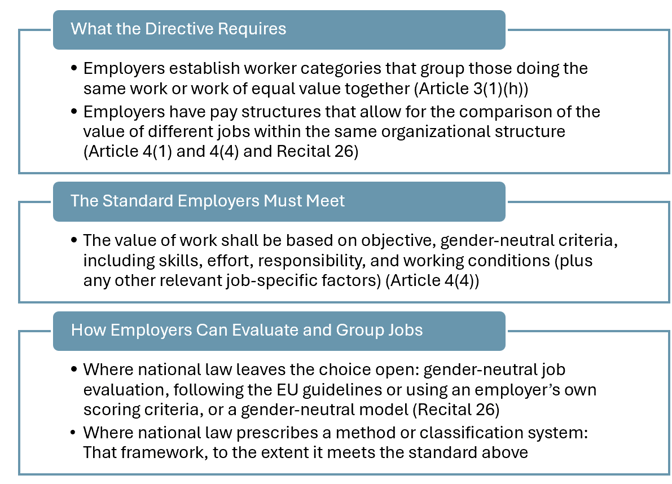
A note on the “same work or work of equal value” phrasing the Directive employs: Although “same work” and “work of equal value” reference distinct legal concepts under the Court of Justice of the European Union, implementation is likely to involve categorization schemes in which a given worker category holds workers performing the same work and workers performing work of equal value. (This interpretation, along with recently issued Member State guidance, is discussed in greater length in last month’s Ask the Navigator installment.)
Additionally, worker categories can be expected to comprise a variety of jobs, the content of which may be very different but the value of which is deemed to be equal across the Directive's criteria. Recital 31 describes gender-neutral job evaluation systems as doing precisely this: comparing jobs whose content differs but whose value is equal. By definition, worker categories are to be based solely on the assessed value of an employer’s jobs (Article 3(1)(h)). Nowhere does the Directive state that worker categories may be defined by structural variables that classify jobs by the similarity of their content or organize jobs by business function or otherwise. In fact, these divisions can mask the very pay disparities the Directive aims to eliminate. (This topic is also discussed in last month’s Ask the Navigator installment.)
How Pay Structures Relate to Worker Categories
Many employers may find the Directive’s language about how worker categories should relate to their pay structures unclear. Our reading is that an employer’s pay structure must indicate, in some way, which jobs are of equal value and which are not. This does not require a one-to-one correspondence between the structure’s levels, grades, bands, or sub-levels and its worker categories. Rather, some delineation within the pay structure must map to groups of jobs reflecting the same work or work of equal value (i.e., worker categories) to meet the Directive’s requirements.[2]
On this basis, a single pay grade—for instance, Grade 5 in a hypothetical pay structure—that comprises multiple equal-value groupings of jobs with no other apparent structural delineation cannot satisfy the Directive’s requirements. But if the grade contains differentiated sublevels—for example, 5A, 5B, and 5C—where each letter corresponds to a grouping of jobs of equal value, that structure could satisfy the requirement.
Employers may also maintain separate pay structures by business unit, department, or job family. However, these structures fail the Directive's standard when they cannot be mapped back to one another, because without a common basis for identifying which jobs across them are of equal value, workers performing work of equal value end up in separate worker categories. For example, if one business function uses pay grades 1 through 10, another business function uses grades A through F, and there is no crosswalk between the two grades, then that pay structure would not meet the Directive’s requirements.
We also expect that all jobs deemed to be of equal value belong in the same worker category. This is not stated in the Directive, but it is supported by EU guidance. So, the Directive does afford employers some administrative flexibility in the design of their pay structures, but worker categories must somehow be reflected in them. Importantly, any compensation practice that treats jobs within the same equal-value worker category differently—whether through the assignment of different pay ranges, the establishment of separate bonus programs or eligibility requirements, or otherwise—has the potential to introduce gender disparities in pay. Employers will need to be in the position to justify those practices on objective, gender-neutral grounds.
Job Evaluation as a Pathway to Compliant Worker Categories
There are a few ways employers may arrive at a compliant pay structure, and Member States are required to make available to employers guidance for doing so. The Directive itself points to two methods: job evaluation and gender-neutral models. In a prior installment, we reviewed in detail the EU’s guidance on conducting a gender-neutral job evaluation. (Readers unfamiliar with job evaluation or the EU’s guidance with respect to job evaluation should refer to that piece for more information.) The Directive offers this approach for rating jobs on the basis of skills, effort, responsibility and working conditions, and also what it refers to simply as “indicators” (Recital 26), for which the Directive provides no definition. However, we traced that term to mean other observable criteria that can be used to objectively score the value of jobs.[3]
There are several points of emphasis from the EU’s guidance on conducting a gender-neutral job evaluation worth mentioning here because they can determine what makes one approach compliant and another not:
- Factors, subfactors, and indicators tie to the Directive’s criteria and capture demands historically undervalued in evaluation systems, disproportionately but not exclusively in female-dominated roles.
- Weighting for factors does not underweight those demands.
- Criteria are agreed with workers’ representatives where they exist (Article 4(4)).
- Evaluators include both men and women, who are trained on the instrument and aware of common gender biases that may affect judgments throughout the process.
- Jobs are assigned to levels by evaluated content, not by matching to an existing grade or to current pay.
- Leveling decisions follow from evaluation scores rather than business unit, job family, or market position, which may indirectly import gender differences into a pay structure.
One other important point the EU’s guidance illustrates is that pay levels are defined by ranges of job evaluation scores, not by identical ones. Jobs within a pay structure’s level will vary somewhat in their scores, and all of them are treated as being of equal value. Worker categories are therefore broader than they may first appear, and equal value is a determination about a range rather than a match.
Using Vendor Models and National Frameworks
We understand the other approach, gender-neutral models, to include a few other methods. Some vendors may have job architecture models that employers may adopt as the basis for their own pay structure. This may involve mapping jobs to the model and using that mapping to define an organization-wide pay structure. To meet the Directive’s standards, the model itself would need to be based on objective, gender-neutral factors tied to skills, effort, responsibility, and working conditions, have been developed in a gender-neutral way, and the mapping of jobs to the model would also need to be conducted in a gender-neutral way.
Another gender-neutral model could involve the use of an existing national framework for categorizing jobs and sorting them into a pay structure based on objective, gender-neutral criteria. Italy offers an example: its industry-specific national collective labor agreements (Contratti Collettivi Nazionali di Lavoro, or CCNLs) contain professional classification systems (livelli di inquadramento) that sort jobs into ranked tiers with associated pay. The same standards that apply to the vendor models apply here, too: these classification systems need to be based on objective, gender-neutral criteria specified by the Directive.
Many national frameworks of this kind predate the Directive, so it may be unclear whether they meet its standards. It is possible that a national framework could be found deficient with respect to the Directive’s requirements. The existence of a framework doesn’t guarantee its compliance. In Italy, for example, adopting a nationally representative CCNL creates a presumption of conformity for employers. Employers there are not obliged to use those frameworks (they may supplement them with their own), but we expect many will reasonably conclude that adopting a national framework is lower risk, even with some unanswered questions. However, that is a legal judgment and a place for external legal counsel to weigh in.
Considerations for Multinational Employers
Multinational EU employers can probably already imagine how a patchwork of different frameworks for grouping jobs can create compounding complexity. On one hand, jobs may already be cataloged based on these frameworks, but the risk profile could vary as a function of nation. On the other hand, conducting their own EU-wide job evaluation adhering to the Directive’s standards and national laws, could afford them a lower risk and portable solution for creating pay structures and grouping jobs into worker categories. Whether an employer builds one instrument or works within multiple frameworks does not change the questions it may face from workers’ representatives, in a joint pay assessment, or in legal proceedings.
4. What Documentation Should Employers Keep for Worker Categories?
Worker categories are the output of a process, and the record of that process is what an employer will need to produce if those categories are challenged.
Up to this point, we’ve discussed how worker categories should be built but what determines whether they can be defended is whether an employer can show evidence they were appropriately constructed. Worker categories are really the output of a process—one that should be conducted in a well-structured, gender-neutral way, employing best practices, and using quality inputs. A record of those inputs and methods is what employers will need to furnish in the event their worker categories do get called into question.
So, what documentation should employers maintain? To answer that question, we’ve developed a worker category documentation checklist.
.png?width=645&height=495&name=image%20(18).png)
We also recommend that worker category assignments exist as a maintained field in an employer’s HRIS. This can facilitate employers fulfill worker right to information requests and calculate pay gaps by worker category for reporting.
Ultimately, to be defensible, worker categories require employers to not only follow Directive and Member State requirements when developing them, but to document their development so that they may be defended if necessary. We realize that many employers may still have questions about the specific state of their pay structures or worker categories they plan to use, how to determine whether they are compliant, and what steps they may need to take to get them to a place where they are defensible. In a future installment, we will provide employers guidance on how to triage their situation with respect to pay structures and worker categories and share steps employers may need to take to reach compliance and mitigate risk.
DCI Consulting helps employers turn complex EU Pay Transparency requirements into clear, defensible pay decisions before reporting becomes mandatory. We provide software and consulting solutions to organizations to establish or review worker categories, conduct required gender pay gap analyses, develop targeted remediation strategies, assess pay transparency compliance, and provide guidance on right to information requests. Visit our EU Pay Transparency Directive page to learn how your organization can prepare to confidently meet upcoming deadlines and subsequent reporting requirements.
- Article 9(5) permits Member States to require employers with fewer than 100 workers to provide pay information, so some jurisdictions may extend the reporting obligation below this threshold.
- EU guidance presented in the European Institute for Gender Equality’s EU-wide Guidelines on Gender-Neutral Job Evaluation and Classification adopts an approach in which jobs determined to be of equal value are classified into the same job group or pay grade, and those classifications are then reflected in the employer’s pay structure. This guidance therefore supports alignment between equal-value groupings and the pay structure, although employers may use different structural terminology.
- Earlier EU materials used the term “indicators” in connection with job evaluation: A 2017 European Parliament resolution called for “specific job evaluation tools with comparable indicators to assess ‘value’ in jobs or sectors,” immediately followed by reference to objective job-value criteria such as skills, effort, and responsibility (European Parliament resolution of 3 October 2017 on women’s economic empowerment in the private and public sectors in the EU, 2017/2008(INI), paras. 25–26). The reference to “indicators” did not appear in the Commission’s original Pay Transparency Directive proposal, but it did appear in the Council’s December 2021 General Approach (Council Doc. ST 14317/21, Recital 15).