 Murray Simpson, Ph.D.
 Brittany Dian-Hansell, M.S.
By Murray Simpson and Brittany Dian-Hansell
BLOG OVERVIEW: The EU Pay Transparency Directive (Directive (EU) 2023/970) required all 27 member states to transpose it into national law by June 7, 2026, but only four met the deadline. EU Member States now fall into four categories: fully transposed (Slovakia, Italy, Lithuania, and Malta), partially implemented (Belgium, Ireland, and Poland), delayed with a published draft (10 states), and delayed with no draft at all (10 states, including Germany, Spain, and Sweden). Missing the deadline carries legal consequences. The European Commission can open infringement proceedings under Articles 258 and 260 TFEU, and workers may seek damages from non-transposing states under the Francovich and Dillenkofer line of case law. With the first gender pay gap reports due June 2027, employers should act now by following a four-stage readiness plan to build compliant, defensible pay practices across the EU.
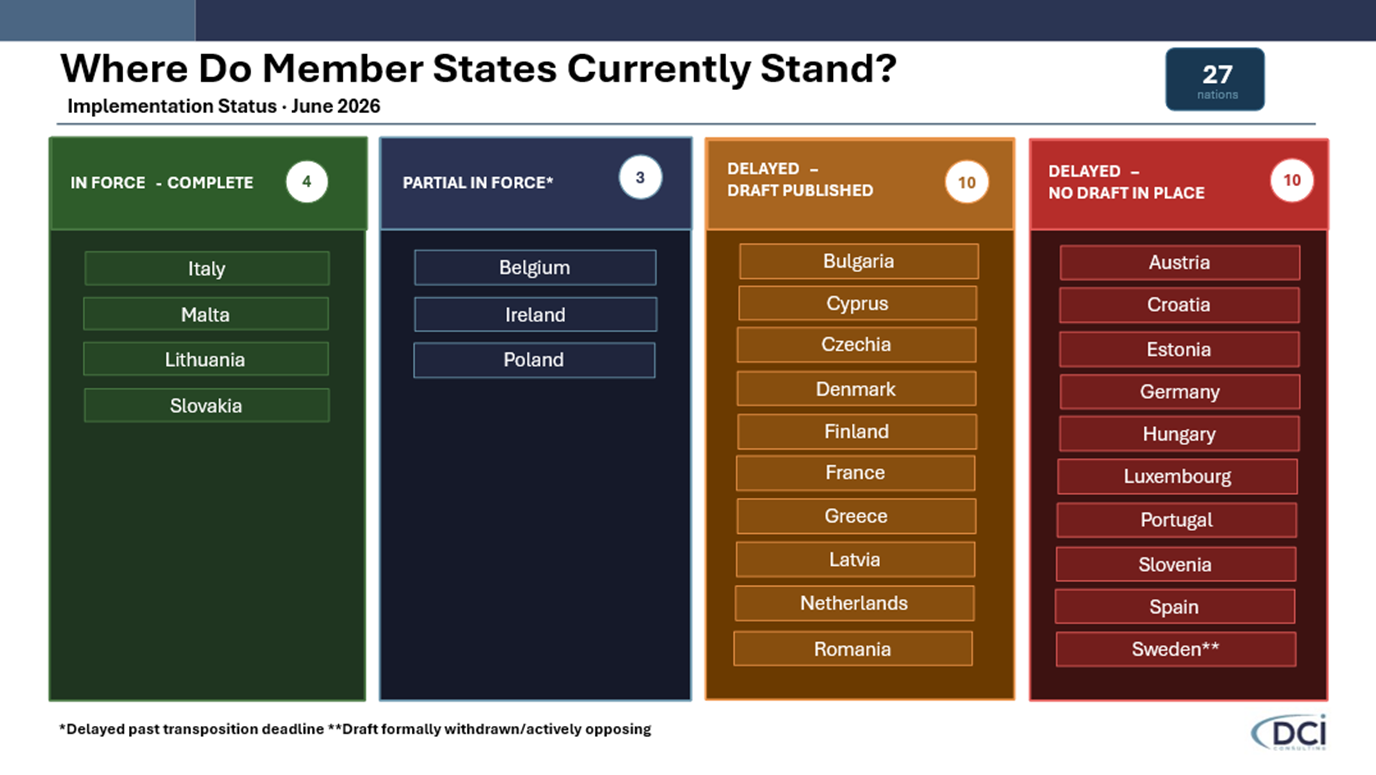
The long-awaited deadline has come and gone. As of June 7, 2026, all 27 EU Member States were required to have transposed the EU Pay Transparency Directive (the Directive), or Directive (EU) 2023/970, into national law. However, as highlighted below in DCI’s implementation tracker, the final picture is that of a very fragmented reality with one clear conclusion: The vast majority of Member States are not ready. Currently, only four Member States fully crossed the finish line, while the remaining 23 find themselves in varying states of non-compliance, partial implementation, or active resistance.
For employers operating in these member states, this is not a moment to sit back and wait. While the legal landscape may be fragmented, compliance obligations under the Directive still stand, and in many respects, increases the complexity. With the first mandatory gender pay gap reports due in just twelve months, the window for preparation is closing fast.
PART I: THE FINAL SCOREBOARD – 27 NATIONS, 4 CATEGORIES
DCI’s tracker consolidates the implementation landscape into four categories reflecting the post-transposition deadline reality. As the infographic clearly shows, those member states experiencing delays dominate the overall picture. Twenty of the 27 member states are now formally behind, split between those with at least a published draft in place and those that have not yet published any legislation at all.
The Four That Made It
Slovakia holds the distinction of being the first EU Member State to fully transpose the Directive, having adopted Act No. 76/2026 on Equal Pay for Men and Women on April 15, 2026. Slovakia's law closely mirrors the Directive's minimum standards while introducing several meaningful expansions, including a July 31, 2026, deadline for employers to have compliant pay structures in place and the inclusion of same-sex equal pay protections.
Italy joined Slovakia as the second country to achieve full transposition before the deadline and was the first major EU economy to reach this achievement. The official Legislative Decree No. 96/2026 was published in the Official Gazette on June 1, 2026. Italy's approach anchors equal work comparisons to national collective bargaining agreement frameworks, a distinct element that provides an early example of how large member states may operationalize the Directive.
Lithuania passed comprehensive amendments to its Labour Code ahead of the deadline, becoming the third member state to fully transpose the Directive. The legislation exceeds the Directive's minimum requirements in several areas, including mandatory remuneration policies for all employers regardless of size. Another notable feature is that SoDRA, Lithuania’s State Social Insurance Fund Board, will calculate gender pay gap metrics using payroll data submitted by employers. Implementation is phased through the end of 2026, with employers required to prepare for SoDRA’s monthly reporting framework by December 31, 2026. Employees’ right to obtain pay comparison information will become operational on January 1, 2027, once SoDRA begins calculating and providing the underlying pay gap data.
Malta enacted foundational pay transparency measures through Legal Notice 112 of 2025 in August of 2025 and completed its full transposition through Legal Notice 173 of 2026 on June 5, 2026, ahead of the deadline. Malta’s most notable departure from the Directive’s minimum standards centers around a much stricter right-to-information (RTI) framework where employers have only eight days to respond to an initial employee request for pay information, with potential enforcement consequences if information provided is not complete or accurate within 45 days.
The Partial Picture: Three States with Some Provisions in Force
Three member states—Belgium, Ireland, and Poland—have enacted at least some Directive-aligned provisions but fall short of full transposition. Each carries a public acknowledgment that full implementation will come later, as reflected by the single asterisk in our tracker.
Belgium enacted French Community public-sector legislation effective January 1, 2025. Full federal private-sector transposition remains pending, and Belgium has formally requested that the European Commission postpone sanctioning proceedings by six months.
Ireland attained partial implementation through its existing pay gap reporting framework. It published the General Scheme of its transposition legislation in January of 2025 but confirmed in May 2026 that it would not achieve full compliance by the deadline. Phased implementation extending into 2027 is planned, and the government has indicated it will not penalize employers for incomplete compliance in the near term, though it remains to be seen what enforcement actions may be taken against Ireland itself.
Poland has had Labour Code amendments in force since December 24, 2025, covering recruitment transparency and salary disclosure. A comprehensive standalone bill covering pay gap reporting and the remaining Directive obligations was revised on April 29, 2026, and published by the Government Legislation Centre on May 4, 2026, but has not yet been referred to the Sejm for parliamentary consideration. Given the bill’s current status and proposed six-month implementation timeline, full transposition is unlikely before early 2027.
Delayed, but Draft Published: Ten Member States
Ten Member States missed the deadline but have at least published draft-implementing legislation. This category reflects a meaningful spectrum of legislative readiness.
France is among the most advanced of the delayed member states, though final adoption by Parliament is not expected before late 2026, making a 2027 entry-into-force date increasingly likely.
Denmark had been targeting January 2027, but the snap general election on March 24, 2026, and the subsequent coalition negotiations has created some uncertainty around this initial target.
The Netherlands has maintained a January 2027 target, with their bill drawing particular attention for its proposed delay of first pay reporting obligations for large employers to June of 2028, a provision that conflicts with the Directive’s June 2027 deadline.
Finland's Ministry of Social Affairs and Health updated its project schedule in May 2026, with the government proposal expected to reach Parliament in mid-late June 2026, making late 2026 or early 2027 the most likely entry-into-force scenario.
Czechia's March 2026 draft adopts a self-described “minimalist” approach to transposition and targets a January 1, 2027, entry-into-force date. While certain pay transparency obligations would apply from that date, gender pay gap reporting requirements would not take effect until 2028.
Cyprus published a comprehensive draft, initially in November 2025 and updated in January 2026, that goes beyond Directive minimums, including criminal sanctions and potential officer liability for non-compliance. Although they had originally targeted June 7, 2026, for full transposition, legislation was not finalized in time and the deadline was missed.
Latvia's March 2026 draft takes a comparatively narrow definition of pay and a more limited set of job evaluation criteria than those laid out in the Directive, potentially reducing the range of factors considered in equal work assessments.
Bulgaria published a draft in May 2026 with a consultation window extended to June 18, 2026.
Greece’s draft was published on June 3, 2026, just four days before the transposition deadline, and entered into a public consultation period that ran from June 3-17, 2026.
Romania originally published draft legislation on March 30, 2026, but the government’s collapse in May 2026 created significant uncertainty around the legislative timeline. Until a new government is formed and legislative priorities are clarified, the timing of transposition remains uncertain.
Delayed with No Draft Published: Ten Member States
The most striking category in our implementation tracker contains ten member states that entered the Directive transposition deadline date without any published implementing legislation. This group includes some of the EU's largest and most influential economies.
Germany, the EU's largest economy, has not published a Referentenentwurf despite an expert commission submitting its final report to the Federal Ministry in November of 2025. Given the absence of a ministerial draft and the remaining legislative steps, full transposition is likely to be delayed until late 2026 or early 2027.
Spain has not yet published draft legislation despite being one of the EU’s largest member states. This is particularly notable given Spain’s recent €6.83 million penalty and daily fines for missing the transposition deadline of the Work-Life Balance Directive. While the circumstances are not identical, Spain’s exposure to similar enforcement action is significant.
Sweden's situation remains unique, and it carries a double asterisk in our tracker as the only member state to formally withdraw its draft legislation and actively oppose transposition of the Directive in its current form. On March 26, 2026, the government announced that it would not submit a transposition bill to the Riksdag and withdrew its proposal while pursuing changes to the Directive at the EU level. Notably, Sweden has identified January 1, 2027 as a potential national implementation date if those efforts prove unsuccessful.
Estonia occupies a distinctive position among Member States with no draft legislation. Its Economic Affairs Minister publicly stated that the country would "rather pay a fine than meet the deadline," citing concerns about the Directive’s administrative burden on businesses.
Austria, Croatia, Hungary, Luxembourg, Portugal, and Slovenia round out this category, and collectively represent a quieter form of non-compliance: No public declarations of opposition, no high-profile enforcement history, and no published drafts. Slovenia and Portugal were expected to produce draft legislation ahead of the deadline but did not. Austria and Hungary have given no public indication of an implementation timeline. Luxembourg, despite its status as a founding EU member and the seat of several EU institutions, similarly has no documented transposition activity. Croatia, which joined the EU in 2013, lacks the type of established pay transparency framework found in several other Member States, meaning transposition may require more foundational legislative development than in countries with existing pay reporting or transparency requirements. None of these six Member States have publicly indicated a target implementation date.
What Does All This Mean for Employers?
The fragmented transposition status of EU Member States creates a genuinely complex compliance environment. Employers operating across multiple EU jurisdictions now face a patchwork of requirements: Four countries with fully enacted law, three with partial provisions, ten with published drafts at varying stages of advancement, and ten with no legislative framework at all. Several enacted and draft laws go beyond the Directive's minimums in ways that create additional obligations that employers will need to track carefully. The most pressing question for employers now is how to move forward.
A practical starting point, regardless of where national law stands, is to follow a structured readiness plan built around the Directive's core obligations. DCI's recommended approach breaks this down into four sequential stages: First, satisfy day-one pay transparency obligations by ensuring pay ranges are disclosed to job applicants, salary history questions are removed from hiring processes, and employees are informed of their right to request pay information; second, evaluate jobs to define categories of workers performing work of equal value, using objective, gender-neutral criteria covering skills, responsibilities, effort, and working conditions; third, conduct a provisional pay gap analysis across those defined categories to identify where gaps exist and whether they can be objectively justified; and fourth, develop a clear strategy for addressing any gaps of 5% or more—the threshold that triggers a mandatory joint pay assessment under the Directive. Organizations that have already begun this foundational work will find themselves significantly better positioned as national laws come into force in the months ahead.
DCI Consulting has been tracking member state transposition developments throughout this process and will continue to monitor legislative changes as they occur. Our EU Pay Transparency services are designed to help employers across all 27 member states build compliant, defensible pay practices ahead of the 2027 reporting deadlines, wherever national transposition efforts currently stand.
Part II: Legal Actions Non-Transposing Member States May Face
With the deadline of June 7, 2026 behind us, attention now shifts to legal actions that member states who failed to fully transpose the Directive may face. The European Commission has held firm throughout the process, refusing to postpone the deadline and putting member states on notice that they could be subject to “infringement proceedings” if they did not complete transposition of the Directive by the stated deadline.
What Are Infringement Proceedings?
Article 258 of the Treaty on the Functioning of the European Union defines infringement proceedings as a three-step process, which is explained here in the context of a member state failing to transpose the Directive by the deadline. In the first step, the European Commission sends a letter formally notifying the member state that it failed to fulfill its obligation to transpose the Directive. In the letter, the Commission requests a response, typically within two months, from the member state that explains its non-compliance with the transposition obligation.
If the member state’s response is unconvincing, the Commission, in the second step, delivers a reasoned opinion on its legal case against the member state, the actions required to comply with the transposition obligation, and a deadline for coming into compliance.
If the member state is not compliant within the allotted time, the Commission, in the third step, refers the case to the Court of Justice of the European Union. Section 3 of Article 260 of the Treaty on the Functioning of the European Union addresses the specific instance of a member state’s failure to transpose a directive and allows the Commission, at the time of its initial referral of the case, to propose lump sum or daily penalty payments for the Court to consider. If the Court judges the member state to be non-compliant, it issues a finding of infringement with required compliance measures and any lump sum or daily penalties the member state must pay. These payments cannot exceed the amount proposed by the Commission and take effect on a date set by the Court.
Can Workers Claim Damages in Non-Transposing Member States?
The Treaty on the Functioning of the European Union has no articles providing damages or remedies to workers when a member state fails to transpose a directive like the EU Pay Transparency Directive. Instead, case law arising from decisions of the Court of Justice provides the basis for workers to pursue claims for damages against member states that fail to transpose the Directive by the deadline. In particular, the Court’s decisions in a series of cases during the 1990s established a legal principle of member state liability under which workers today could claim damages from a member state for not transposing the EU Pay Transparency Directive into national law by the prescribed deadline.
First, based on the Court’s opinion in Francovich v Italy (1991), a worker could claim damages from a non-transposing member state if the worker successfully shows (i) the Directive confers rights on the worker, (ii) the content of those rights is identifiable from the Directive, and (iii) there is a causal link between the member state’s failure to transpose the Directive and losses suffered by the worker. However, in the joined cases of Brasserie du Pêcheur SA v. Federal Republic of Germany and R v Secretary of State for Transport, ex parte Factortame (No 3) (1996), the Court held that a member state must commit a sufficiently serious breach of EU law in order to be liable for harm to individuals or businesses, meaning the member state “manifestly and gravely disregarded the limits of its discretion.” Thus, while Francovich established conditions under which a member state could be found financially liable to individuals harmed by its failure to transpose a directive, Brasserie du Pêcheur and Factortame called into question whether non-transposition itself constitutes a sufficiently serious breach of EU law. The Court resolved this question in Erich Dillenkofer and Others v Federal Republic of Germany (1996), holding that non-transposition of a directive by the prescribed deadline automatically rises to the level of a sufficiently serious breach.
Within a strict interpretation of this legal framework, 23 of the 27 EU Member States could be found liable under Dillenkofer for a sufficiently serious breach of EU law because they failed to fully transpose the EU Pay Transparency Directive by the deadline of June 7, 2026. Such a finding, however, would first require workers within a non-transposing member state to show that the Directive confers identifiable rights on them, which, based on the following examples, does not seem too difficult.
The Directive repeatedly references a worker’s right to equal pay. To facilitate the securing of this right to equal pay, it specifically grants a worker the right to request information about his or her own pay level and the average pay levels of women and men, respectively, who perform work that is the same or of equal value to that of the inquiring worker. The Directive also confers on a worker the right to discuss and disclose his or her own pay for purposes of enforcing the principle of pay equity. Other rights are conferred through actions that the worker’s employer is required by the Directive to take. For example, an employer must make the criteria used to determine pay levels and pay progression easily accessible to the worker, unless the employer is exempted from providing such access because the employer has fewer than 50 employees. The employer, likewise, must provide all its workers with gender pay gaps computed by categories of workers and broken down by ordinary basic wage and complementary or variable components of pay.
Workers, however, cannot prevail in claiming damages from a member state unless they demonstrate the actual losses they suffered as a result of the member state failing to transpose the Directive. Proving such losses may be difficult in the absence of national laws that implement the Directive, leaving workers hard pressed to solve a classic cart-before-the-horse problem.
Can Workers Sue Their Employers for Damages Arising from Non-Transposition?
While case law provides a legal path for workers to follow to hold member states liable for not transposing the Directive by the deadline, workers do not have a corresponding path to sue their employers for damages arising from the Directive’s non-transposition.
However, once national laws implementing the Directive are in place, workers can initiate administrative or court proceedings against employers for failure to comply with those laws. Article 14 of the Directive specifically requires member States to ensure that court proceedings for the enforcement of rights and obligations relating to equal pay are easily accessible to workers. Importantly, for a worker initiating such a proceeding, Article 18(2) of the Directive automatically shifts the burden of proof from the worker to his or her employer, without the worker needing to establish a prima facie case, in instances where the employer allegedly breaches any of the following: pay transparency obligations prior to employment (Article 5), transparency of pay setting and pay progression policy (Article 6), right to information for workers (Article 7), pay gap reporting (Article 9), and joint pay assessments (Article 10). The burden shifting, however, does not apply if the employer proves the breach in question “was manifestly unintentional and of a minor character.”
What Is Next?
As previously noted, the European Commission did not grant any deadline extensions and stated in December 2025 that initiating infringement proceedings against non-transposing Member States is an enforcement option.[1] With 23 of 27 Member States failing to fully transpose the Directive by the deadline, non-compliance is widespread. Under these circumstances, it will be interesting to see whether the European Commission maintains its hard stance by initiating infringement proceedings or bends in a more conciliatory direction that facilitates and expedites transposition.
DCI will continue to monitor updates regarding pay transparency and reporting requirements in the EU. Sign up for updates here.
[1] https://www.europarl.europa.eu/doceo/document/E-10-2025-004018-ASW_EN.html